BRIEF-01
To the AI data center haters; yes, you are ALL wrong.
You won the votes. I think enforceable power, noise and tax rules beat a blanket ban. The costs are real in some places. So are the benefits.
Key points
- Restrictive outcomes won 46 of 47 decided measures on Ballotpedia’s 2026 list, including 40 of 41 on November 3. Only 19 of the measures were bans. NBC’s exit poll found 76% of voters opposed a new data center in their community.
- PJM’s market monitor put added capacity costs from data-center demand, actual and forecast, at $29.4 billion through four auctions in its September filing. It proposes new generation to serve new load.
- MIT estimates about $3 a month overall and $7 at investor-owned utilities. Public utility effects are smaller, and it finds none at co-ops.
- A ban can stop local harms. Regional bill effects depend on forecast demand, location and timing. Gross tax receipts are part of the trade.
- Loudoun’s FY2027 budget expects about $1.3 billion in data-center taxes, roughly $2,900 per resident using Census 2025 population. These are gross receipts.
You won. Some of you are right about the harm. All of you are wrong about the answer.
I build AI systems for a living. I have a stake in this. I want more of this work built here. I also want the people who build it to pay their way.
A ban can keep the next noisy plant out of town. It cannot erase costs from plants elsewhere on your grid. It can also turn away a future tax check. I would demand a deal that pays for its costs. Make them pay, make them follow the rules, and make them keep the noise down. I would take that deal over a ban.
You won the votes
On Ballotpedia’s 2026 list, the restrictive side has won 46 of 47 decided measures, including 40 of 41 on November 3. It took 73.7% of the votes cast across those questions, with some people counted on more than one question. Three more votes come in December, and the list still has gaps.1
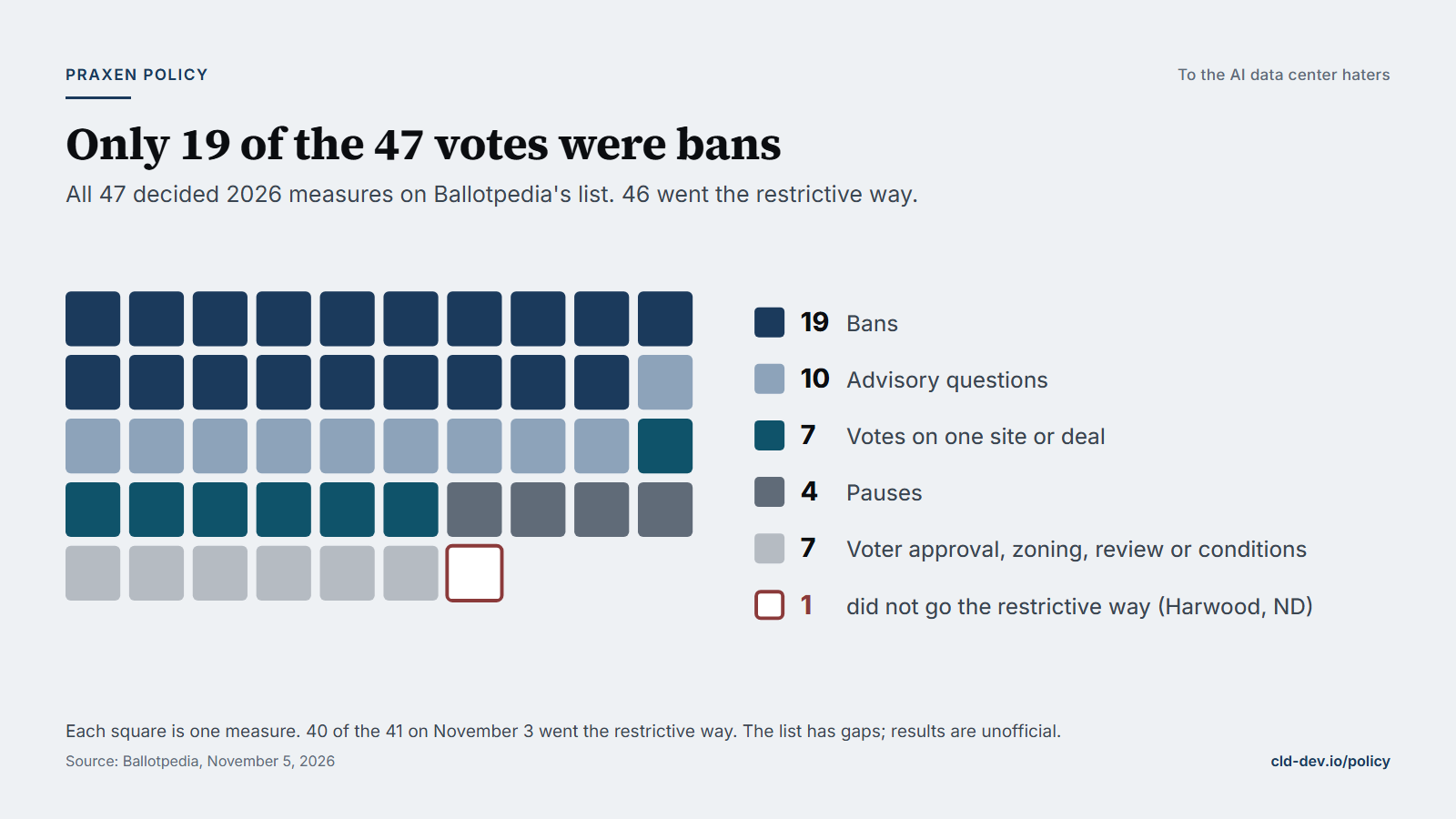
Every decided 2026 data-center measure on Ballotpedia’s list, by type. Source: Ballotpedia, November 5 snapshot.
Those were different choices: 19 ban measures, ten advisory questions, seven votes on a site or deal, four pauses, and seven measures on voter approval, zoning, review or conditions. Perry, Ohio, voted for bonds and noise limits tied to special tax deals. That is closer to the answer I want than a blanket ban.2
NBC’s November 3 exit poll found 76% of voters opposed a new data center in their community, and 56% called AI and data centers a crucial or major factor in their vote for Congress. Gallup’s March 2–18 poll found seven in ten adults opposed one in their area. Fox’s July 17–20 poll found 78% of registered voters wanted to slow construction until concerns were addressed. Sherrod Brown and James Talarico both hit their opponents over data centers in ads and won their Senate races. Opposition has won far more than a few town meetings.3
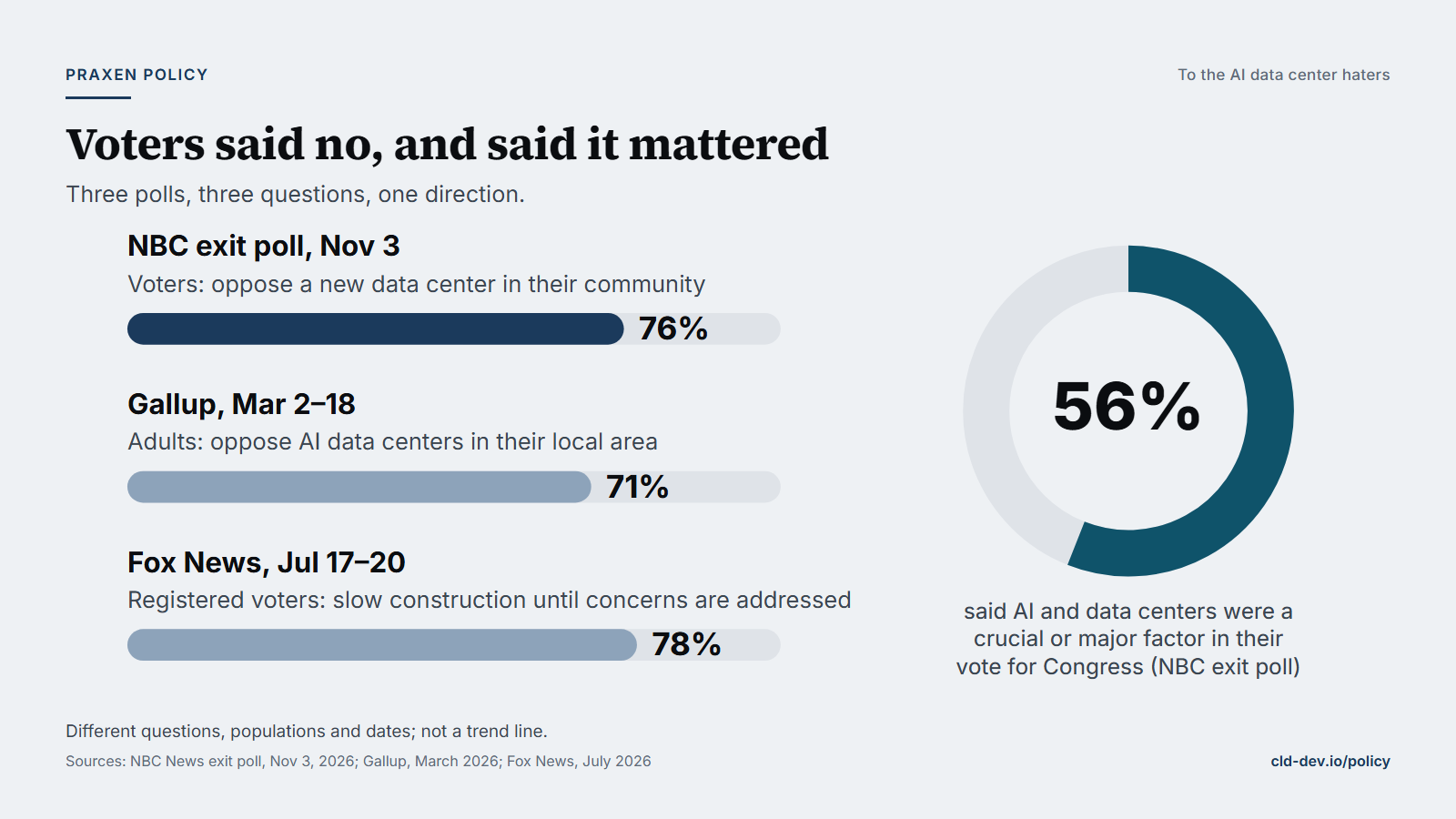
Three polls with different questions and populations. Sources: NBC News exit poll; Gallup; Fox News.
If you fought one bad project to make it obey the rules, I am not talking about you. I mean people who decided the answer was to ban, pause or stop the buildout. You have every right to say no. I think you chose wrong.
Where you are right
Memphis first. Mississippi’s July 30 order lists 69 temporary gas turbines at xAI’s plant in Southaven, just across the state line from its Colossus 2 data center. The state treats them as exempt mobile sources and lets them run without separate air permits until retirement dates that reach July 2027. Reuters reported in July that the plant sits near predominantly Black neighborhoods already estimated to have high asthma rates. xAI made the same exemption argument in court. On October 30, a federal judge rejected it and let the NAACP’s lawsuit go forward, after refusing the Justice Department’s request to dismiss the case. The ruling does not decide whether xAI broke the law. I won’t defend this. Keep fighting it.4
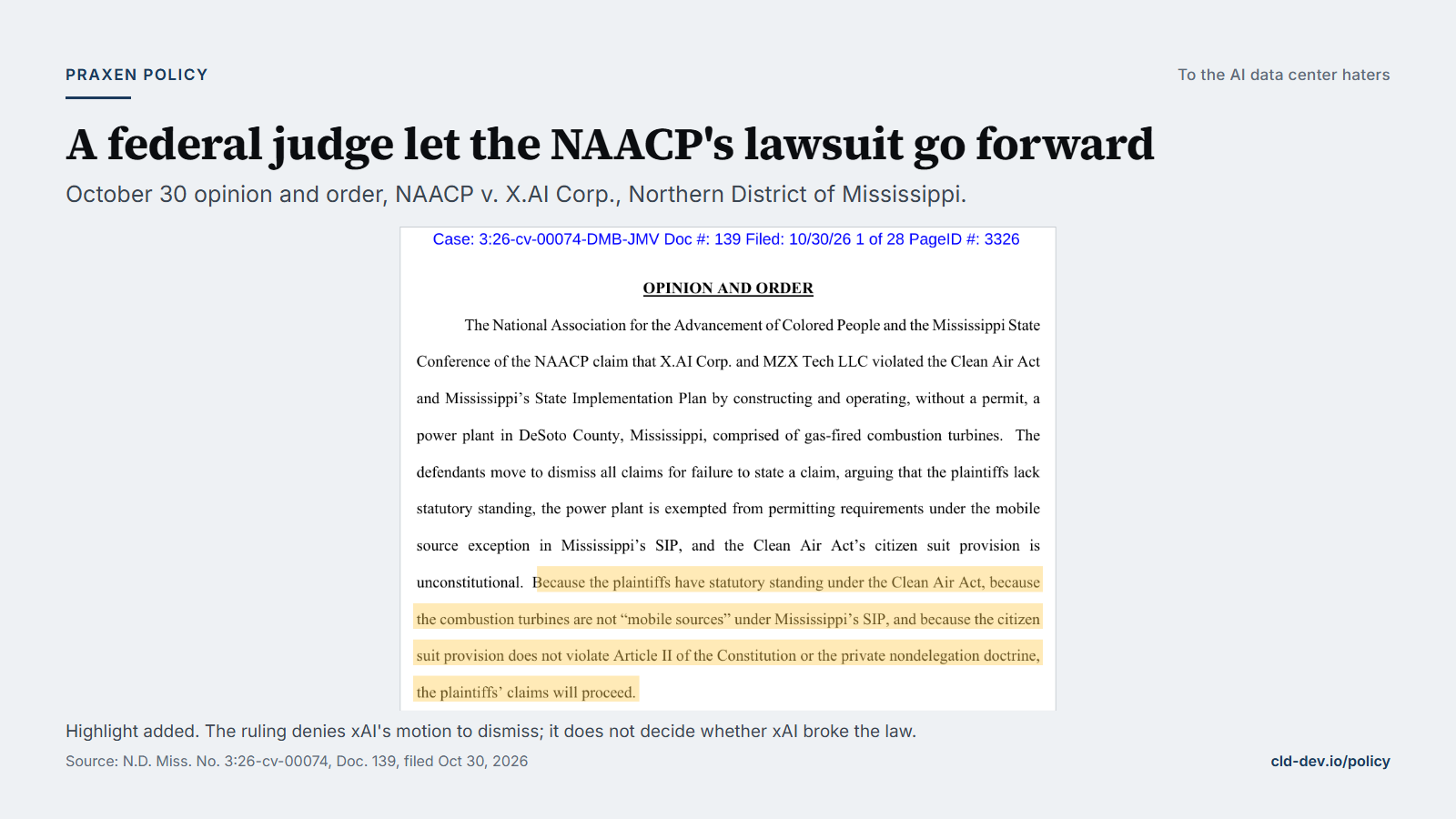
October 30 opinion and order, NAACP v. X.AI Corp., first page; highlight added. Source: N.D. Miss. No. 3:26-cv-00074, Doc. 139.
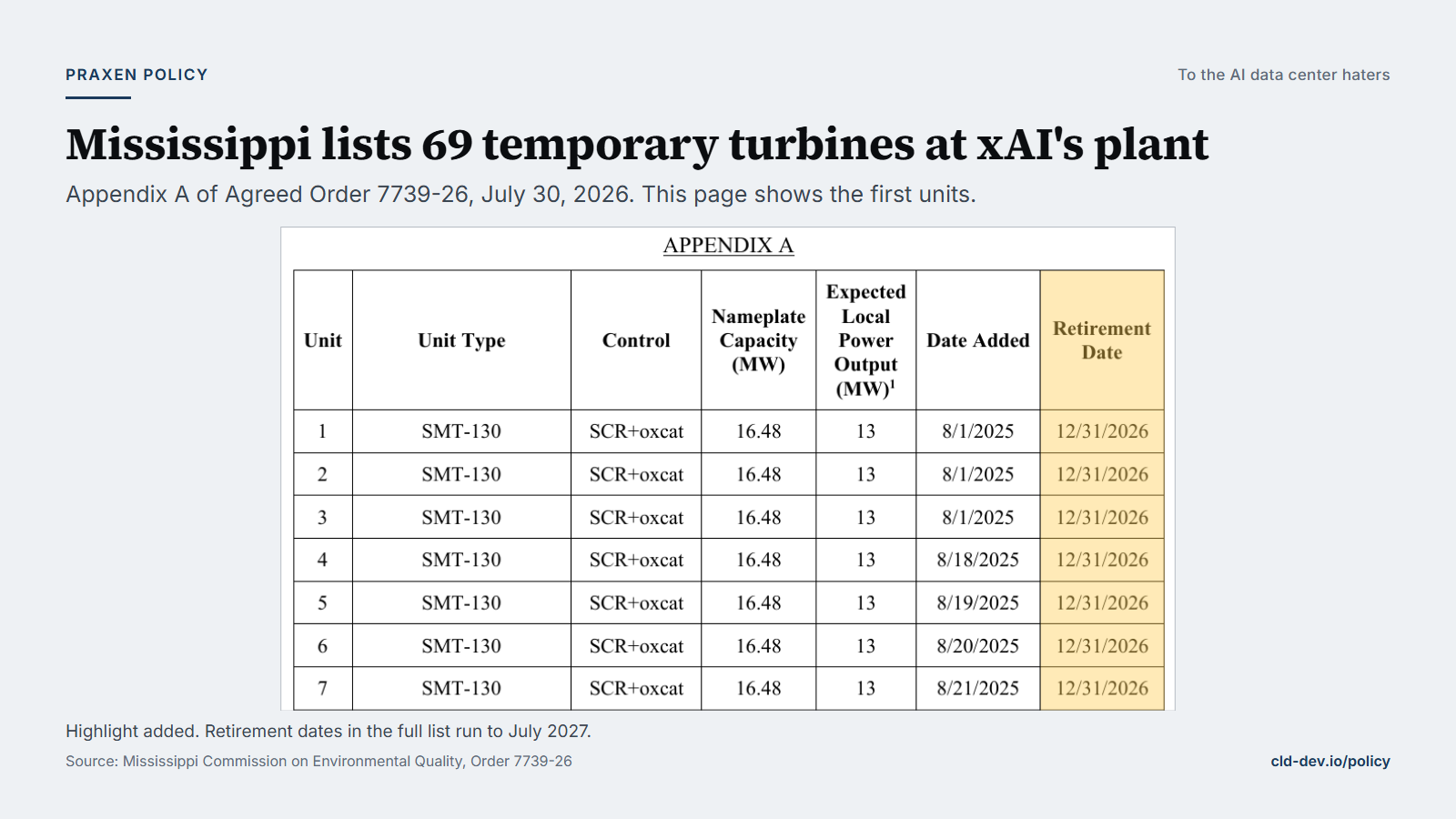
Appendix A of Mississippi Agreed Order 7739-26, first units; highlight added. Source: Mississippi Commission on Environmental Quality.
Bills in PJM are real too. PJM runs a regional grid and markets across parts of the eastern United States. Its independent watchdog, called the market monitor, put added capacity costs from existing and forecast data-center demand at $29.4 billion through four auctions in its September filing. Capacity is the payment for having power ready when needed. You did not sign up to bankroll Big Tech.5
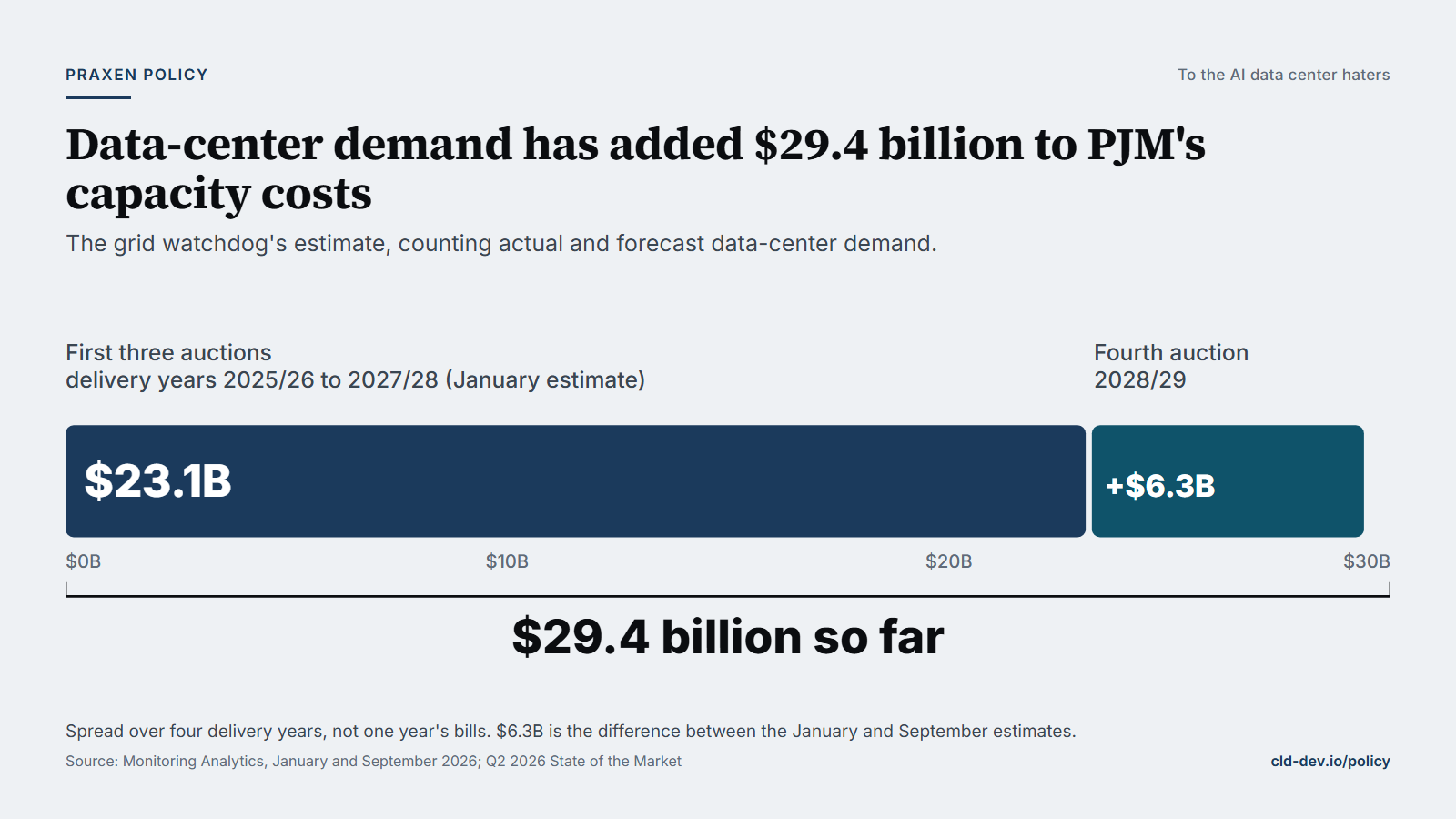
The market monitor’s estimate of added capacity costs from actual and forecast data-center demand. Sources: Monitoring Analytics, January and September 2026; Q2 2026 State of the Market.
Noise: if you live next door and hear it at night, you are not imagining it. Virginia’s 2024 legislative audit found that some neighbors report harm to their well-being, even though most sites generate no complaints.6
Climate: data centers add carbon dioxide, and the share is growing. It is also small. The International Energy Agency puts the CO2 from their electricity at about 180 million tonnes in 2024, 0.5% of the total from burning fuel. Planes emitted about 5 times as much, and making cement about 12 times as much. If climate is your reason to stop data centers, there are far bigger targets.7
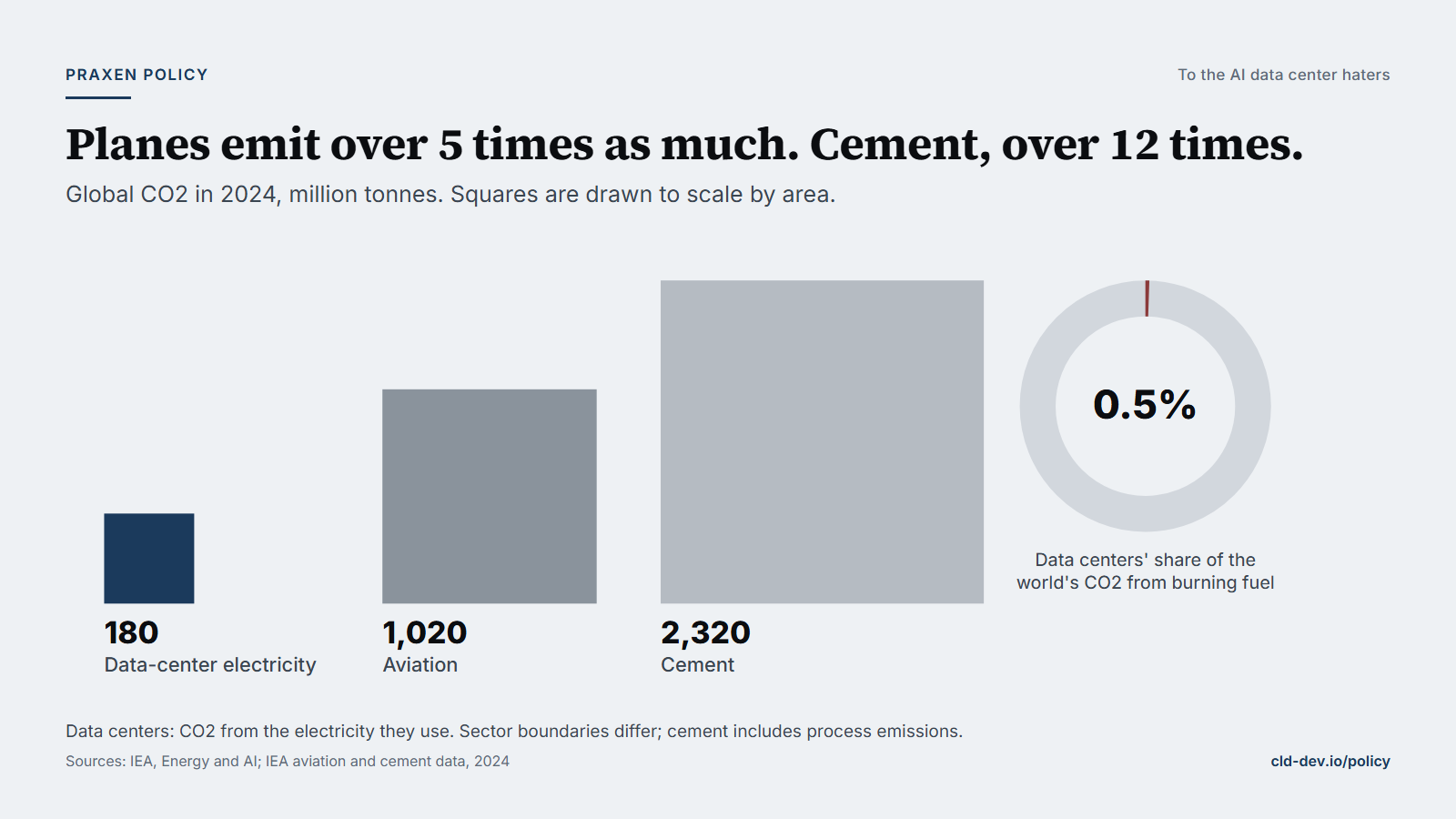
Global CO2 in 2024, squares drawn to scale by area. Sources: IEA, Energy and AI; IEA aviation and cement data.
Jobs: a finished data center employs few people. Virginia’s 2024 audit gives a typical example of about 50 ongoing workers, against 1,500 at peak construction. Those 1,500 are real jobs. Hospitals, highways and stadiums are built the same way, by crews that move on when the work is done. That’s how construction works, not something AI invented. A promise of thousands should still say which kind.6
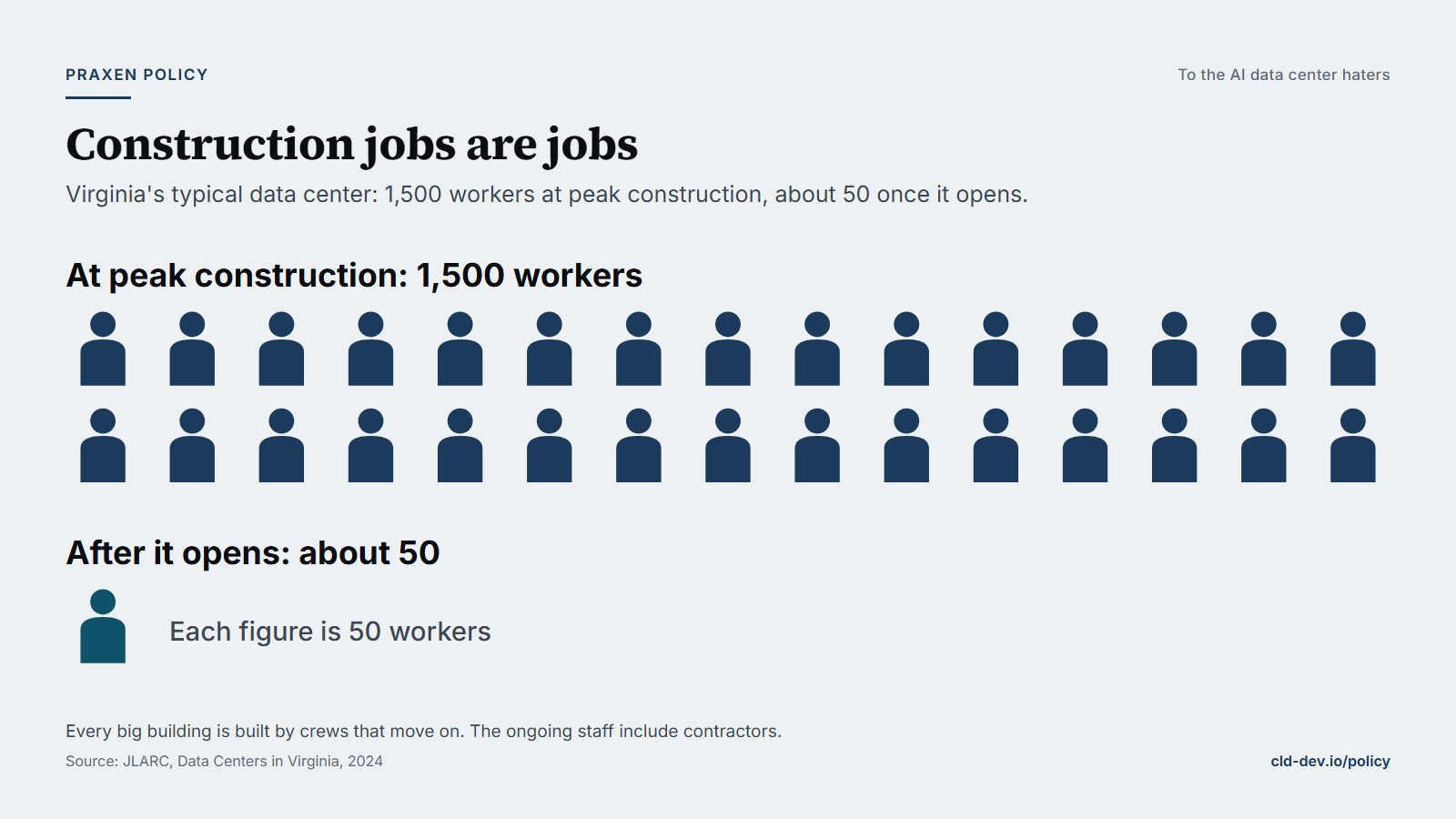
Virginia’s typical data center, at peak construction and after it opens. Source: JLARC, Data Centers in Virginia, 2024.
What you heard about your bill
Elizabeth Warren said people near large data centers had seen their electricity bills rise by as much as 267%. PolitiFact rated the claim Mostly False: the figure describes wholesale prices. She put the wrong price on your kitchen table.8
The estimates for actual household rates are smaller. An October-revised MIT working paper finds about $3 a month on average and about $7 at investor-owned utilities, which serve most customers. It finds much smaller effects at public utilities and none at co-ops. The study ends in 2024, before the 2025/2026 capacity-price jump.9
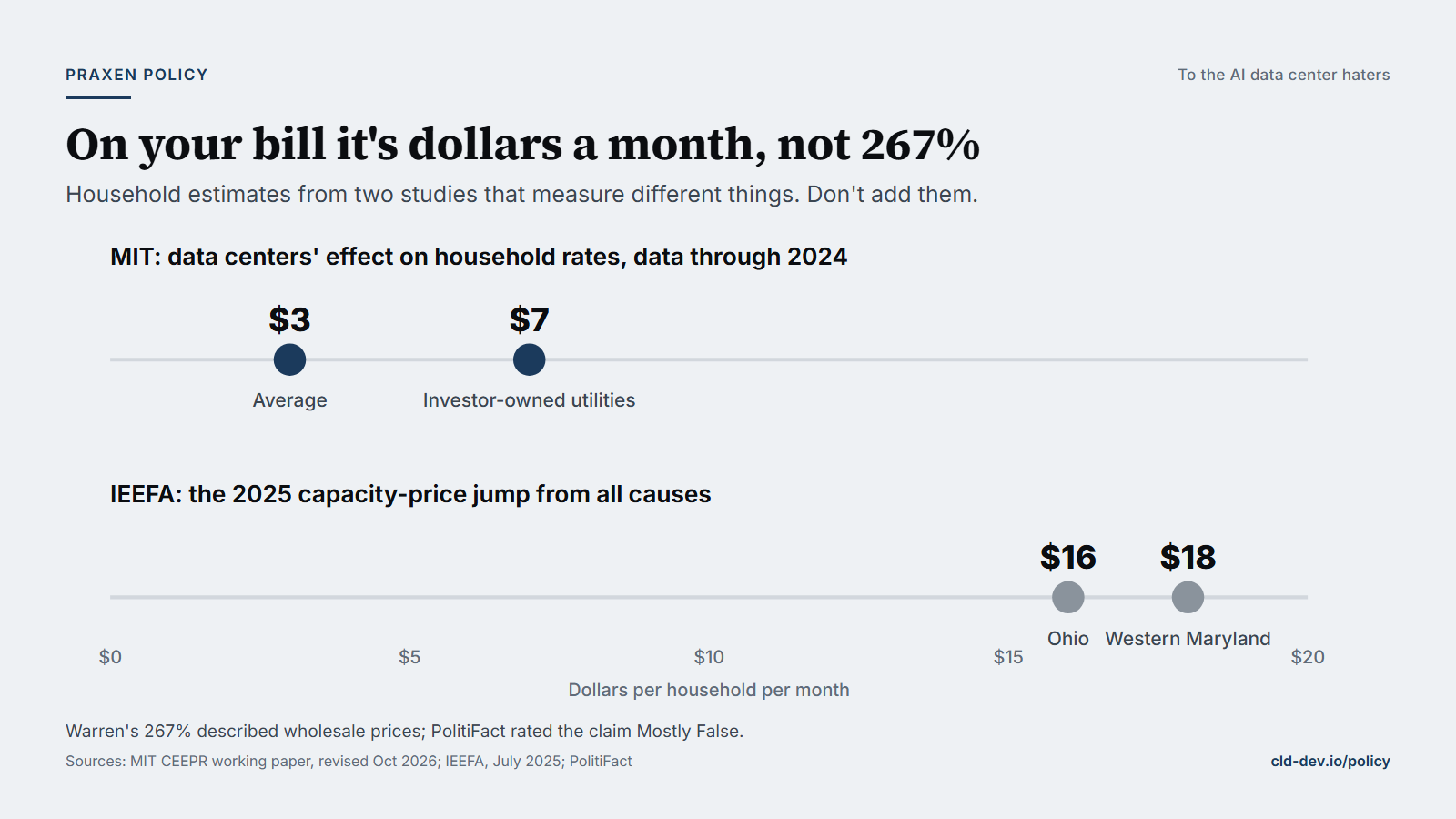
Monthly household estimates from two studies that measure different things. Sources: MIT CEEPR working paper; IEEFA; PolitiFact.
That can still hurt. IEEFA’s July 2025 analysis estimated that the capacity-price jump alone would add about $16 a month in Ohio and $18 in western Maryland. It attributed 63% of the auction-price increase to data centers, citing the market monitor. The monthly figures cover the capacity jump from all causes.10
James Talarico’s ad blamed support for data centers for “skyrocketing utility bills.” FactCheck.org found Texas price increases modest and the causal link uncertain. It called the idea that data centers explain all or most recent US price rises a “misconception.” Ohio’s grid problem cannot stand in for every state.11
Sherrod Brown’s ad said a host community gets nothing except higher bills. Some hosts collect substantial tax revenue. Brown’s claim about that site’s benefits remains unresolved.12
Brown and Talarico both won on November 3. Winning doesn’t settle the claim.
I object to selling every new building as a wrecking ball for your bill. Make its owner pay for the power and wires it needs.
What you heard about water and heat
Water use needs a place, a year and a cooling system attached. Virginia’s 2024 audit found that most data centers there used about the same water as a large office building, or less. A few used much more. I would demand the site’s numbers before approving its water deal.6
Lawrence Berkeley National Laboratory estimated that US data centers used 66 billion liters of water directly in 2023, about 48 million gallons a day. America’s golf courses applied about 1.46 billion gallons a day in 2024, roughly 30 times as much. Add the water behind data centers’ electricity, nearly 800 billion liters more, and the total is about 627 million gallons a day, still less than half of golf’s. That is roughly 0.8% of the freshwater USGS modeled for crops, public supply and power plants. I know golf comparisons haven’t moved many voters. The numbers still matter.13
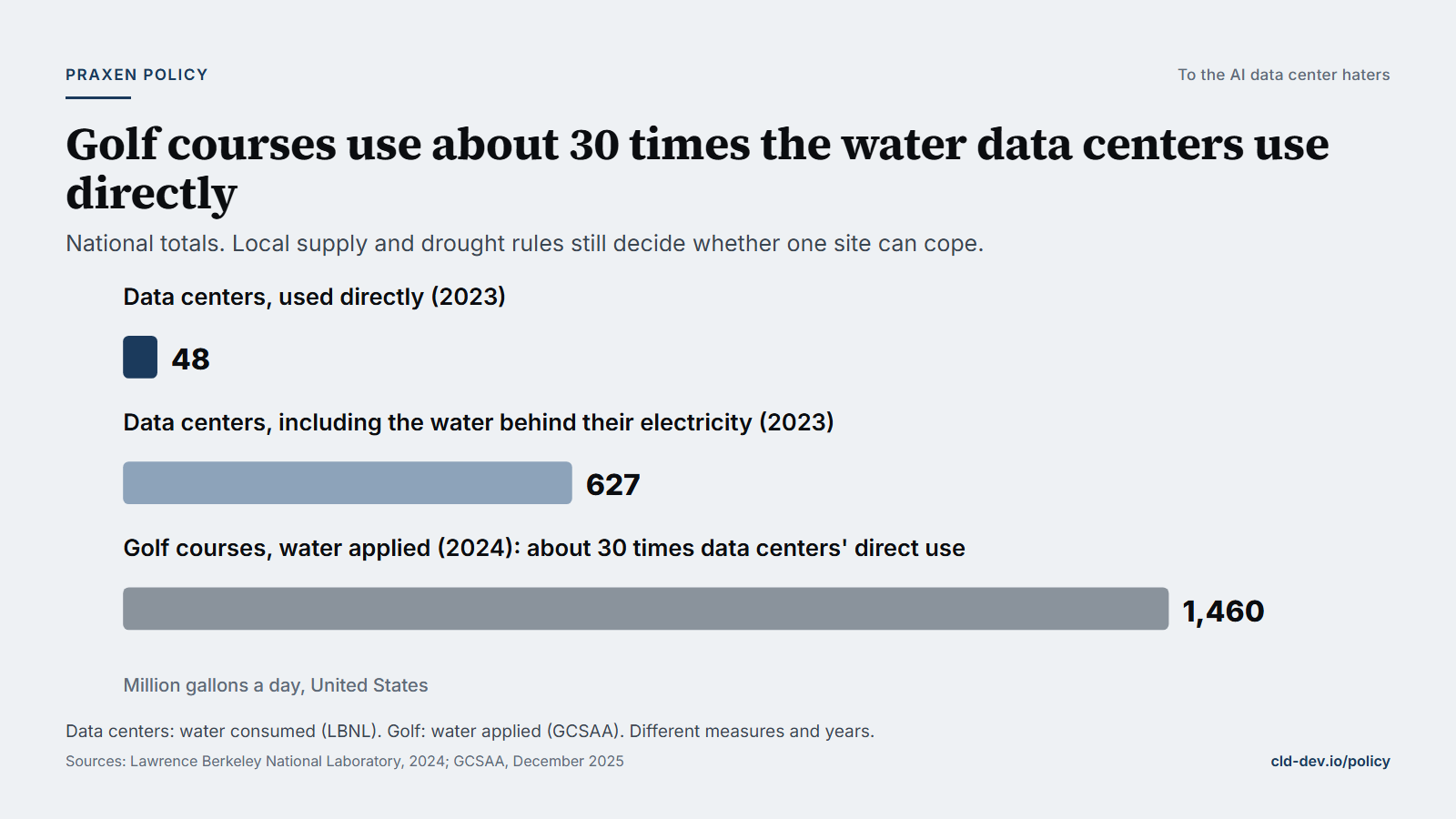
US water use, million gallons a day; different measures and years. Sources: Lawrence Berkeley National Laboratory; GCSAA.
A small national share can sit in a dry town. The local water supply and drought rules decide whether a site can cope. I want a public water budget and a binding limit.
The heat story needs care too. A preprint reports about 2°C of warming in satellite land-surface readings at studied sites. It measures the ground and built surfaces, with the cause still disputed. Turning that into a claim about hotter air in everyone’s home goes beyond the study.14
Why I would take a rule over a ban
A ban works on what it bans. It can keep the noise, turbines and trucks from a new project out of your town. That is a real choice.
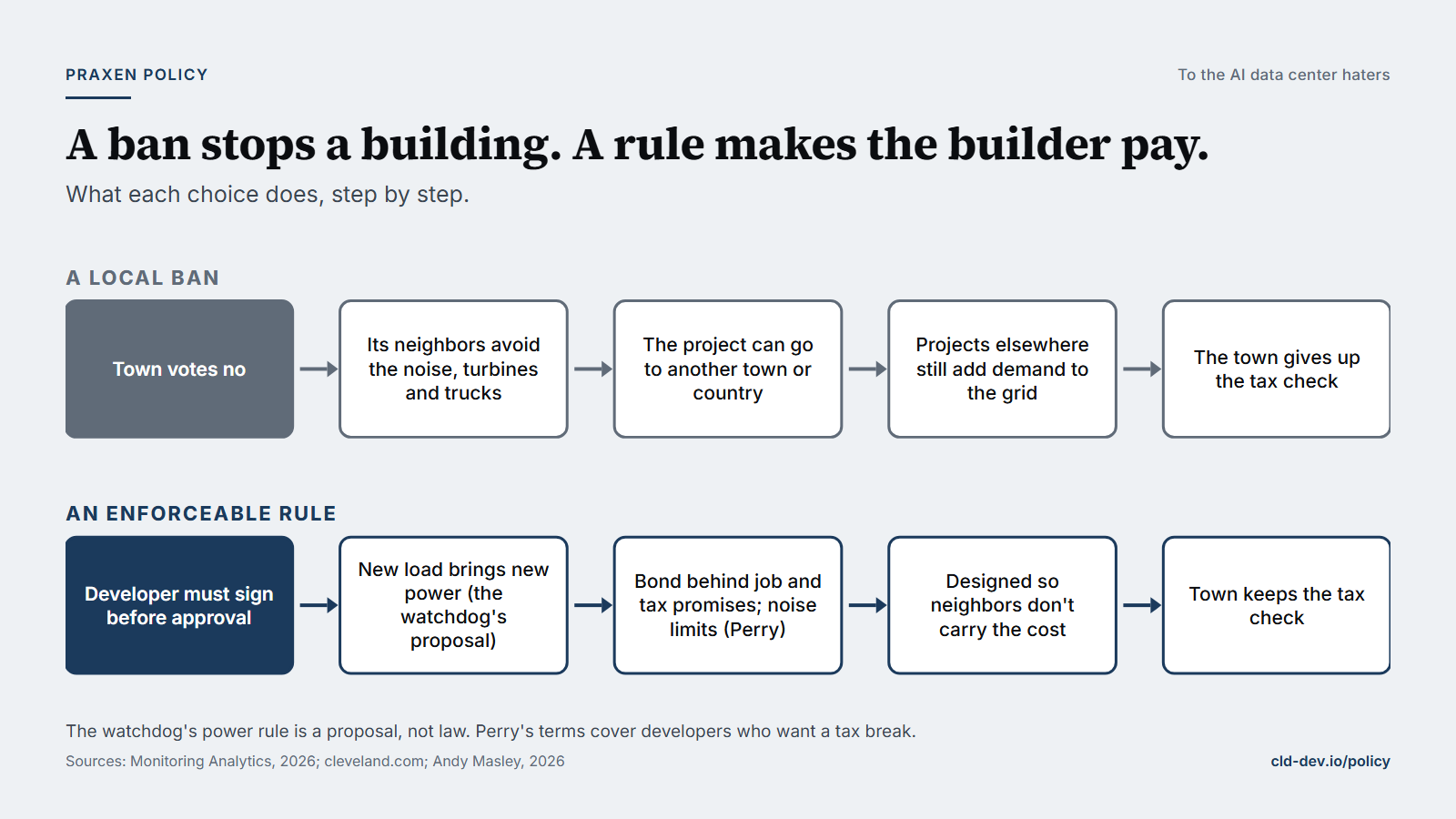
What a local ban does, and what an enforceable rule does. Sources: Monitoring Analytics; cleveland.com; Andy Masley.
A ban also stops less than people think. It stops a building, not AI. AI is geometry, linear algebra and multivariable calculus running on chips, and that math runs the same in Malaysia as in Ohio. Masley worries about AI risk; I don’t. Even so, Masley argues that anything short of a national moratorium with strict export controls is unlikely to slow AI much.15
Arizona Attorney General Kris Mayes called for a pause on August 31. New York’s moratorium promises to lift once standards are final, with local approvals still required. A pause with a route to approval deserves a different argument from a permanent no. I would put the work into enforceable terms and judge each project.16
Enough refusals can also reduce expected power demand. The monitor modeled $6.2 billion less in one auction with all 13,018 megawatts of forecast data-center growth removed. That is the region’s forecast growth, not one town’s project.5
The auction cleared at its price cap. A big site in a constrained part of the grid could affect its local price. The monitor gives no one-campus threshold. A town’s vote controls its own land; projects elsewhere still add demand.17
You’ll say your town can’t write a PJM rule, and Memphis shows rules get dodged. You’re right about PJM, and Memphis is the best argument against me. The state sided with the company, the Justice Department tried to end the case, and it took a lawsuit to get this far. A town still has a zoning code, a signed contract with penalties, and the power to demand guarantees. Perry’s voters did that, 87% to 13%: a developer that wants a tax break must post a bond behind its job and tax promises and guarantee 45 decibels overnight. It only reaches developers who ask for the break. If a developer won’t sign, tell them no. That’s the ban I’d support.2
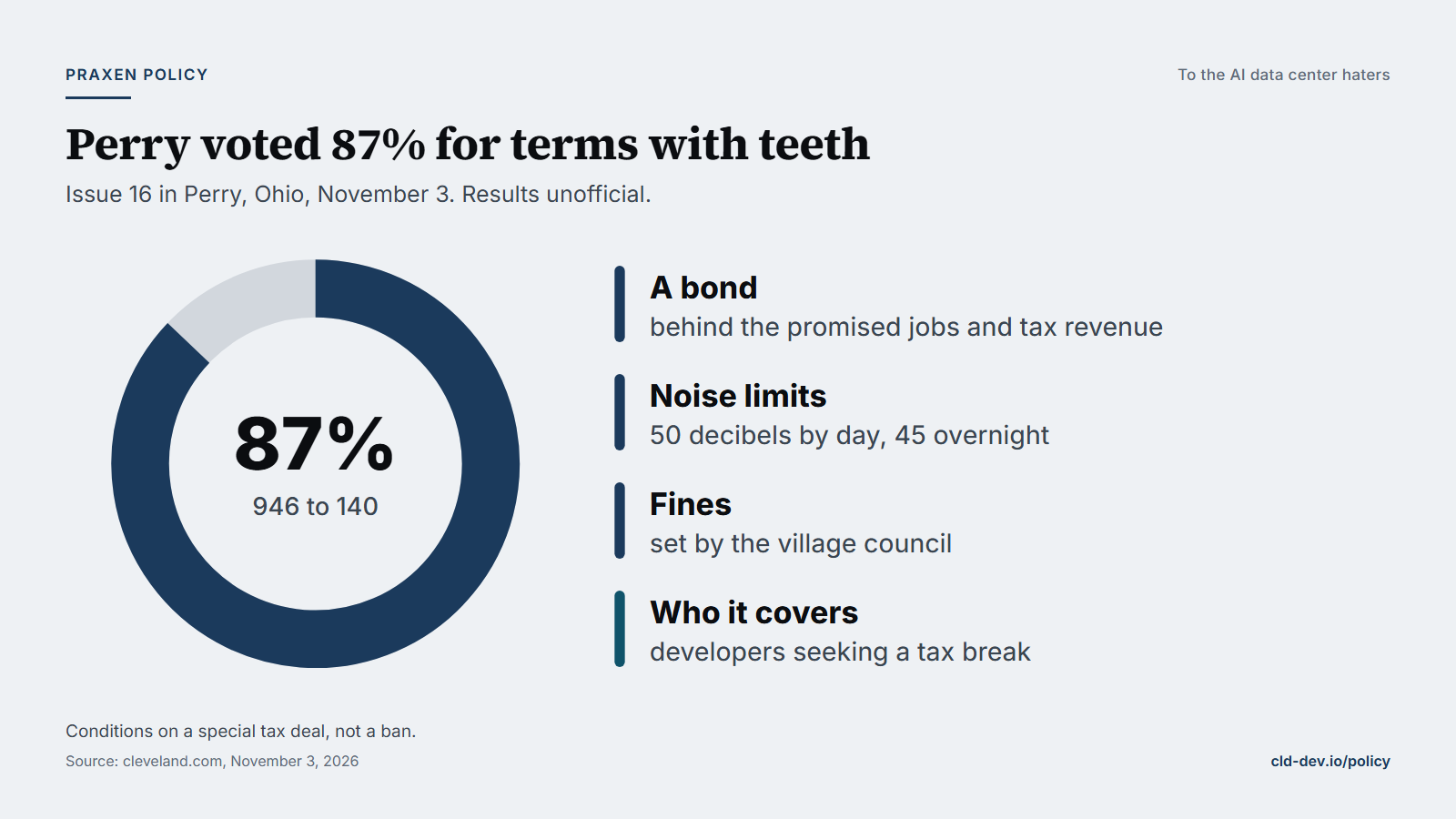
Perry, Ohio, Issue 16, November 3; results unofficial. Source: cleveland.com.
I would start with the watchdog’s proposed fix. Its January report says that if new data-center load had to bring its own new generation, the uncertain forecast’s impact on other customers would be “limited or eliminated,” while existing data-center load would remain an issue unless addressed. Its September filing calls for long-term contracts with new generation that shift no cost or risk to other customers. The monitor asks for a power-supply rule and a queue that holds new load until it can be served reliably. Yes, that queue is a kind of pause. It ends when the power exists, and a developer that brings its own new generation can move faster. That’s the only kind of pause I’d back. The monitor calls the $29.4 billion irreversible. A rule for new load limits what comes next. It does not undo that.18
That rule is a proposal. FERC rejected PJM’s related Bring Your Own New Capacity package in October, including concerns about whether the power could reach the load. PJM’s revised plan to buy extra power supply, called a backstop, is pending. I want that protection written into an enforceable rule.19
Forecasts must be fixed too. In September, the monitor counted about 4,000 megawatts of cancelled or delayed load and criticized a stale procurement target. According to Jefferies’ October 28 note, utilities cut near-term forecasts by 6.5 gigawatts, which could shrink the proposed backstop purchase from about 6.8 gigawatts to as little as 630 megawatts. PJM expects its updated forecast in January; other factors also set the purchase.20
Some rules already exist. AEP Ohio’s tariff makes large data-center customers commit to minimum demand payments and cover certain buildout costs if they cancel. It protects against some stranded costs in that utility’s territory; it does not erase all PJM capacity costs.21
Zoning can set noise limits and buffers. Virginia’s audit found the hum rarely breaks an ordinary noise ordinance, so the limit has to be written for it and enforced.6 Turbine permits can limit emissions, but a permit needs terms that fit the machines’ actual use.4 Neither writes the region’s electricity bill.
Then there is the tax check. Virginia’s 2024 audit found data-center receipts ranged from less than 1% to 31% of local revenue in the five mature host localities it studied. Loudoun is the high-end example: its adopted budget expects about $1.3 billion from data-center property and equipment taxes in FY2027. That is roughly $2,900 per resident using the Census Bureau’s 2025 population estimate, in gross receipts, not money paid to each resident.22
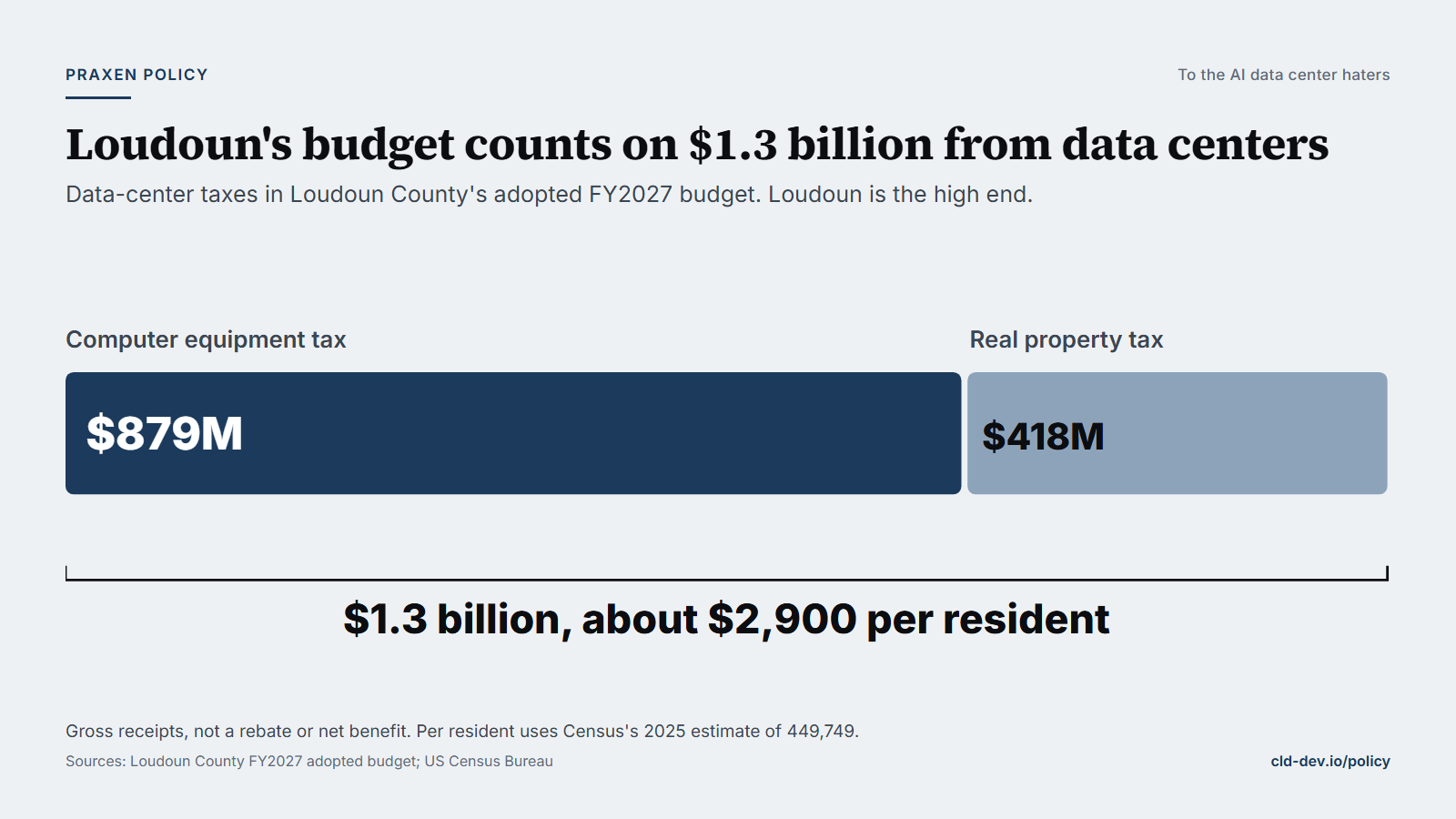
Data-center taxes in Loudoun County’s adopted FY2027 budget, gross receipts. Sources: Loudoun FY2027 adopted budget; US Census Bureau.
A project presentation on Perry’s website forecasts $326 million in property taxes over 31 years across several public bodies, with about $10 million going to the village itself. Those are projected gross receipts. They depend on the project being built and do not settle its net cost.23
Andy Masley’s June 6 reframe asks whether we would spend that much tax revenue to avoid a data center’s harms. I think that is the right question. In August, Masley argued the backlash is mostly about what people believe data centers do to their towns, and that many of those claims are wrong. My view: demand a good, enforceable deal before turning away the building and its possible tax receipts.15
Google still has to follow the rules
Google announced a US$15 billion Malaysia plan for 2027–2028, a roughly US$15 billion India plan for 2026–2030, and at least €13 billion in Finland for 2027–2028. Google expects its Finland build to support more than 37,000 jobs there during construction, about 16,000 of them in construction itself. Malaysia’s construction phase is expected to support more than 37,000 local jobs per year, about 6,000 in construction. Those jobs and tax receipts land in other countries’ towns, not American ones. The announcements don’t tie these plans to our votes. But a project an American town turns away has somewhere else to go.24
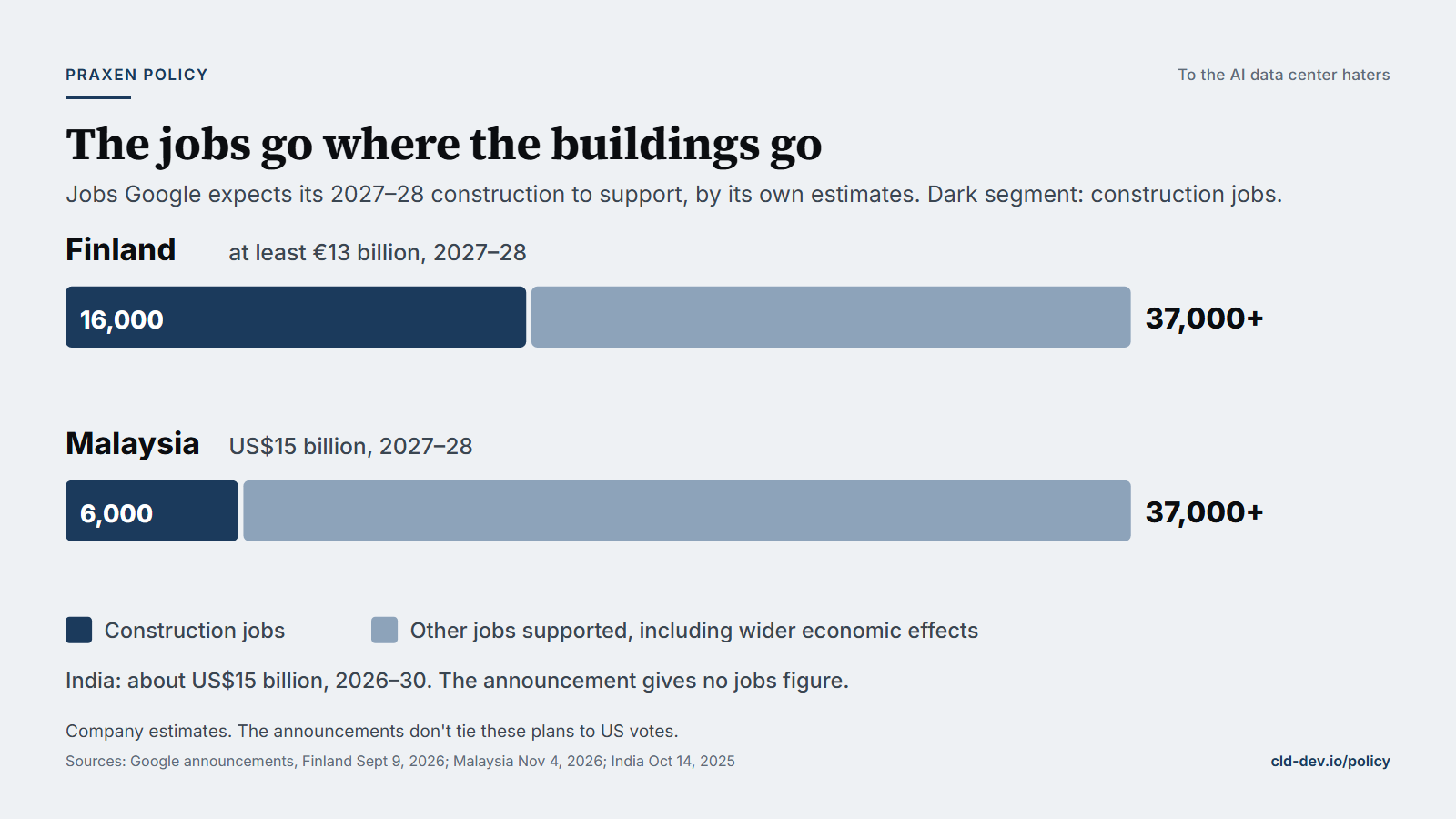
Jobs Google expects its 2027–28 construction to support, by its own estimates. Sources: Google announcements for Finland, Malaysia and India.
Finnish police opened a criminal investigation at Muhos. Authorities allege Google subsidiary Tuike Finland cleared and drained 330 hectares before required reviews finished. Campaigners estimate 250,000 trees were felled. Google says it will cooperate. The company told the regulator it stopped preparatory work at Muhos and Kajaani. Building abroad still means following the rules.25
What the buildings are for
I want to count what we get from AI, not just what goes into it. Here are six results since January 2024, with their limits left in.
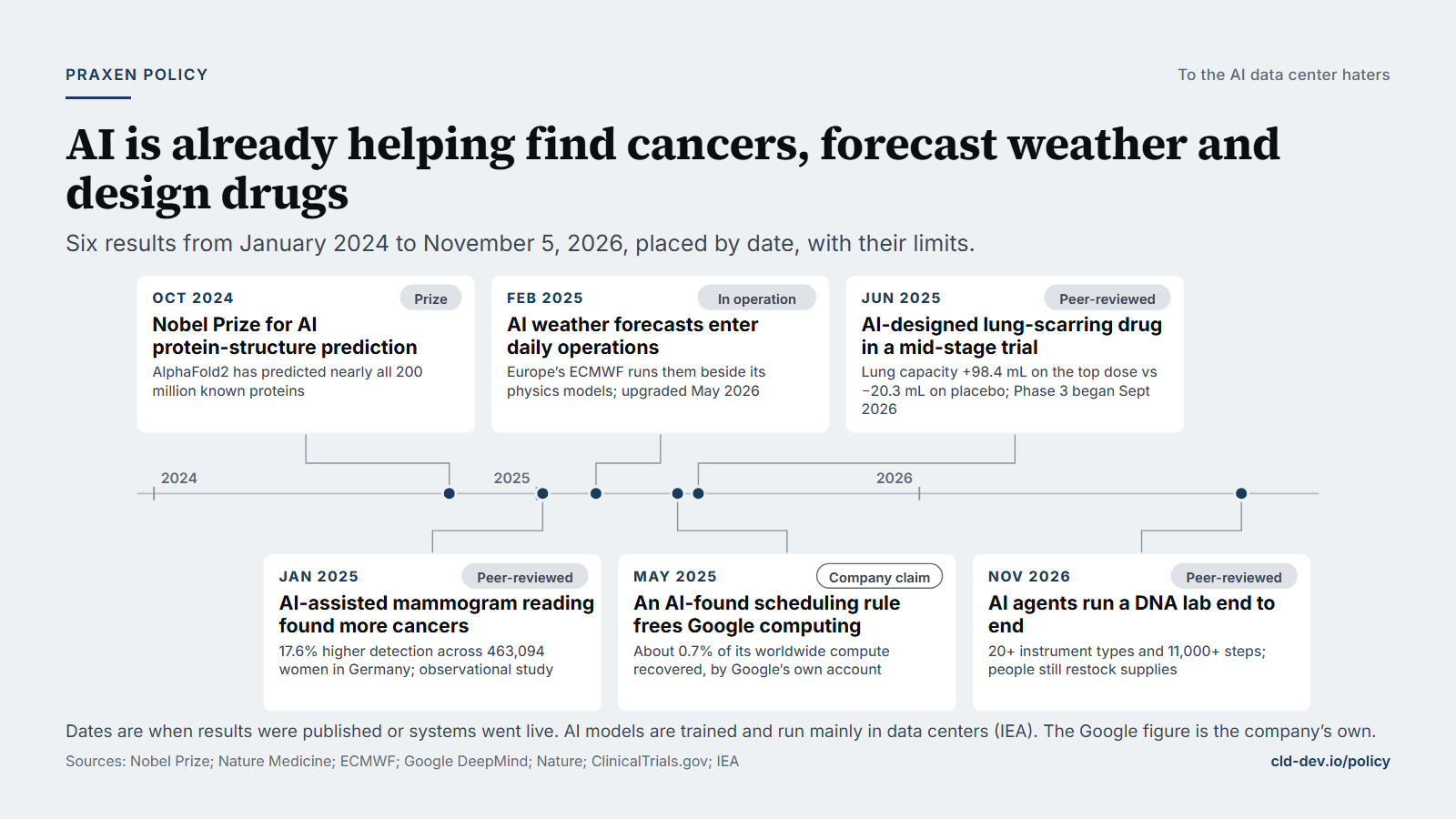
Six AI results since January 2024, placed by date, with their limits. Sources: Nobel Prize; Nature Medicine; ECMWF; Google DeepMind; Nature; ClinicalTrials.gov.
The 2024 chemistry Nobel recognized computational protein design and AI protein-structure prediction, whose AlphaFold2 model had predicted structures for nearly 200 million proteins.26
Germany’s PRAIM study, published in January 2025, found a 17.6% higher cancer detection rate with AI-assisted reading among 463,094 women, an observational result, not proof of fewer deaths.27
ECMWF put its AI weather system into daily operations in February 2025 alongside its physics-based forecasts, and upgraded it in May 2026.28
In a 71-patient mid-stage trial published in June 2025, rentosertib, a drug whose target and molecule came from generative AI, raised lung capacity by an average of 98.4 milliliters on its highest dose, while the placebo group lost 20.3. A 320-patient late-stage trial began in September 2026; the drug is not approved.29
Google says an AlphaEvolve scheduling rule already in use recovers about 0.7% of its worldwide compute, doing more work on the same footprint, not proving a cut in total electricity use.30
A November 4, 2026 Nature paper reports that AI agents in the AutoDNA laboratory ran DNA experiments across more than 20 instrument types and 11,000 steps, and identified a cancer mutation that clinical tests had already found. People still replenish its supplies.31
AI training and deployment happen mainly in data centers; none of these results excuses one bad project.32
Then refuse AI too
If you refuse data centers, you should refuse to use AI for anything. I mean the blanket ban, not Memphis neighbors demanding clean air.
Pew finds 49% of U.S. adults use AI chatbots and 24% use one daily; 60% read the AI summaries at the top of search results.33 Rainey’s September survey finds daily AI users favor a local data center 55% to 36%, while weekly users oppose one 55% to 36%.34 That is the same survey’s split, not a guess from two polls.
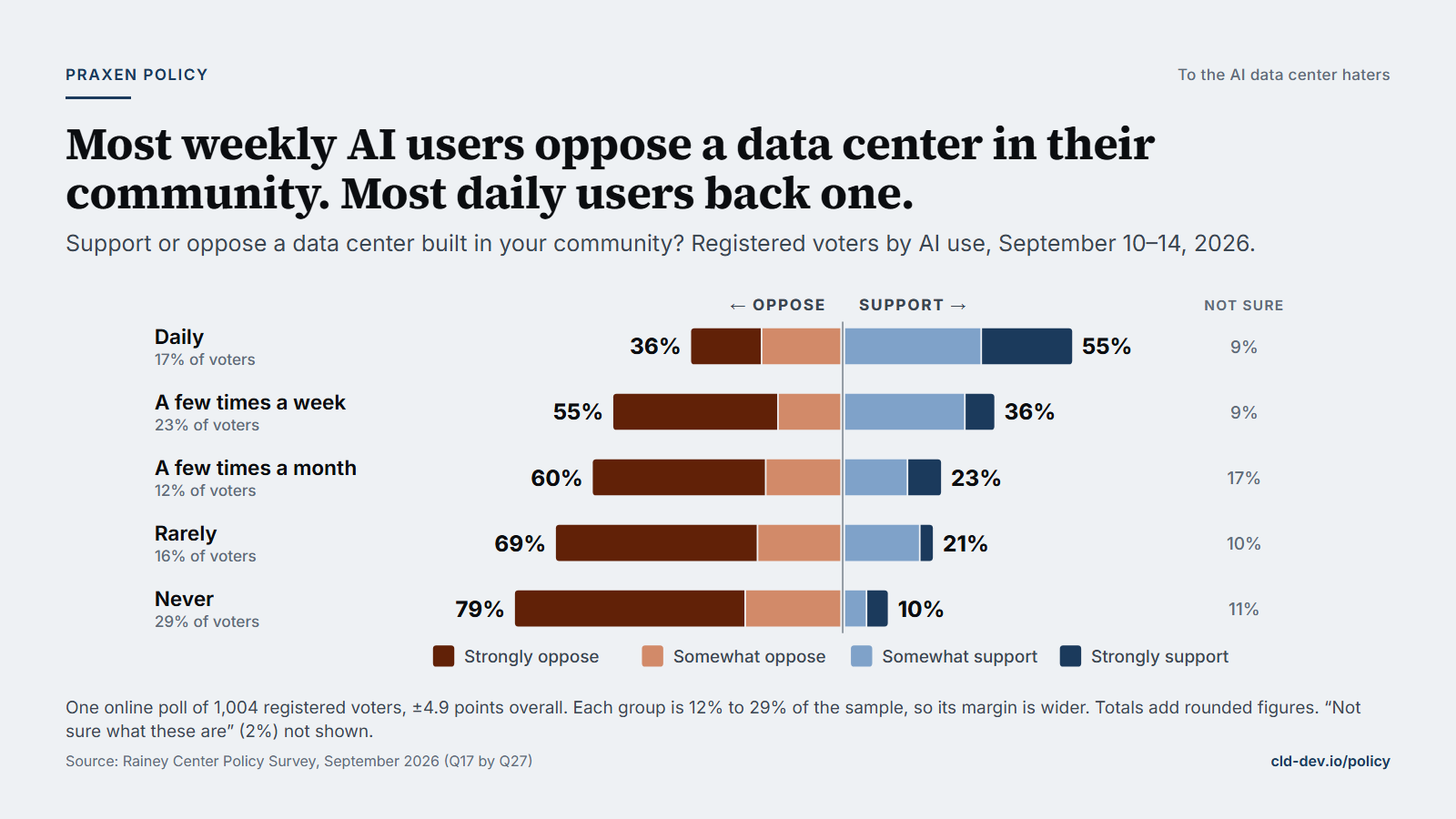
Support for a data center in voters’ own community, by how often they use AI tools. Source: Rainey Center, September 2026 Policy Survey.
ChatGPT and Google Search run in data centers; some other models run on phones and PCs.35 You’ll say AI is hard to avoid, and using it isn’t a vote for a building.36 You can use electricity and still not want a power plant next door. Fair. Then we’re arguing about where and on what terms. That’s a rule, not a ban.
My view
I think AI’s benefits far outweigh its downsides and the prejudice against it, and superintelligence isn’t something I worry about. I think the answer is to build, charge the full cost to the people causing it, and enforce the limits at the fence. I think a quiet, well-sited plant with a sound tax deal beats a blanket no.
Show me a town where enforceable safeguards still leave neighbors paying the bill, and I would back a refusal of that project. Show me that a wider pause cuts costs more than a workable supply rule, after counting forgone gross receipts and avoided harms, and I would change my view. Until then, I think you won the votes and chose the wrong answer.
Notes
-
Ballotpedia measure table. November 5 snapshot. The 47 are every decided 2026 measure on the list: 41 on November 3 and six from March to September. The pooled share is 200,105 restrictive selections out of 271,638 selections across questions, not distinct people. Outcomes are unofficial; the frame is incomplete. ↩
-
Ballotpedia measure table. All 47 decided measures were coded from their individual Ballotpedia pages. Perry’s guarantees measure passed 946 to 140, rounded to 87% to 13%. Nineteen measures are bans. cleveland.com, November 3, reports the bond and the 50- and 45-decibel limits. Results are unofficial. ↩ ↩2
-
NBC national exit poll, November 3, 2026; Gallup data-center opposition poll; Fox July national topline. Gallup surveyed adults; Fox surveyed registered voters. Fox asked about slowing construction until concerns were addressed. These questions do not measure blanket-ban support. TIME, November 4, reports Brown’s five-point win and Talarico’s win over Ken Paxton. FactCheck.org describes both ads. These results do not show the ads decided either race. Exit poll figures can shift as they are reweighted. NBC surveyed voters on November 3; Gallup fieldwork March 2–18, 2026; Fox July 17–20, 2026. ↩
-
Mississippi Agreed Order 7739-26, ordered July 30, 2026. It lists 69 portable turbines, says no more arrive after July 15, and sets retirement dates running to July 2027. The state and xAI subsidiary MZX Tech agree there that operating without separate permits has not violated Mississippi permitting rules. Reuters, July 14, counted 59 from regulator correspondence, at least 57 in Southaven, without federal clean-air permits. Its CDC-data analysis found asthma estimates above the respective county baseline in 27 of 28 tracts within five miles. These are existing disease estimates, not measured effects of these turbines. The October 30 opinion and order, NAACP v. X.AI Corp., N.D. Miss., No. 3:26-cv-00074, Doc. 139, denies the motion to dismiss and addresses at least 27 turbines on site as of April 7. TechTarget, November 2, reports that it does not establish a violation, settle actual emissions or order controls. The Justice Department’s dismissal request was denied on October 19, according to plaintiffs’ counsel. Mississippi separately permitted 41 permanent turbines in March. SELC and Earthjustice represent the NAACP. ↩ ↩2
-
September 25 filing; State of the Market, Section 5. The $29.4 billion is the monitor’s estimated cumulative increase in capacity-market costs from actual and forecast data-center load through the 2028/2029 Base Residual Auction, covering delivery years 2025/2026 through 2028/2029. It is capacity procurement, not all electricity spending or a one-year retail charge. January’s three-auction total was $23,100,955,341. January analysis, Table 11 Scenario 3, removes 13,018 MW of forecast growth and lowers modeled procurement revenue by $6.24 billion with other assumptions held constant. ↩ ↩2
-
Data Centers in Virginia (2024). JLARC’s 2024 Virginia audit. Its typical facility example has about 50 ongoing workers, roughly half contractors, and peaks at 1,500 construction workers. Water and local-revenue findings concern that state and period. ↩ ↩2 ↩3 ↩4
-
IEA AI and climate change. IEA’s 2024 baseline: about 180 million tonnes of electricity-related CO2 from all data centers, against about 35 billion tonnes globally from fuel combustion. The boundary excludes life-cycle and backup emissions; projected growth is a scenario. IEA states the 0.5% share directly. IEA’s 2024 figures are 1.02 billion tonnes for aviation and 2.32 billion tonnes for cement. Dividing each by 180 million gives 5.67 and 12.89; the body rounds down to five and twelve. The sector boundaries differ: data centers cover electricity-related emissions, aviation covers its CO2, and cement includes process emissions. These are comparisons of sector totals, not equal services or life-cycle footprints. ↩
-
PolitiFact on Warren household-bill claim. Warren’s June 5 statement is quoted by PolitiFact on June 12. The original post on X could not be opened for this piece. ↩
-
Who Pays for Growth? October-revised working paper. October-revised working paper using data through 2024. Its average residential translation is $3.21 monthly overall and $7 at investor-owned utilities; those utilities serve more than 70% of customers. Results vary by utility ownership. The causal assumptions were not independently replicated here. ↩
-
IEEFA July 2025 capacity costs. July 30, 2025 analysis. The $16 and $18 estimates cover the capacity-price jump from all causes. The 63% share applies to the auction-price increase and is attributed to the market monitor. It is not 63% of a retail bill. ↩
-
Data Centers and Electricity Prices. The original ads could not be viewed for this piece. Ad wording is quoted via FactCheck.org; the underlying videos were not independently transcribed. Its Texas assessment does not dismiss evidence from other markets. ↩
-
Data Centers and Electricity Prices. Brown’s exact ad sentence is quoted secondarily by FactCheck.org. The original ad could not be viewed. The local claim is not proved false merely by showing benefits elsewhere; its no-benefit absolute is unresolved for that site. Bill harms can be true in specific places. ↩
-
LBNL 2024 data center energy and water report; USGS freshwater consumption for three uses. LBNL’s 2023 direct and indirect consumption estimates total nearly 866 billion liters. USGS Table 4 averages 82,821 million gallons daily for three freshwater uses in the contiguous US over 2010–2020. The ratio is about 0.76%, across different periods and a partial national denominator. LBNL’s indirect estimate includes hydroelectric reservoir evaporation; the three USGS categories omit that use. This further raises the ratio relative to a matched-boundary comparison. LBNL’s June 2026 update revises electricity use, about 176 TWh in 2023 and a projected 303 TWh in 2026, and gives no new water figure, so this 2023 water estimate is likely low for today. GCSAA release. GCSAA reports US golf facilities applied a projected 1.63 million acre-feet in 2024. At 325,851 gallons per acre-foot, that is about 1.46 billion gallons a day. Golf’s figure is water applied and LBNL’s direct figure is water consumed, in different years. The USGS comparison covers the lower 48 states over 2010–2020 and leaves out other uses. TIME reports golf comparisons have done little to reassure voters. TIME, November 4. Daily golf figure uses a 365-day annualization; dividing by all 366 days of 2024 gives about 1.45 billion gallons, with the same roughly 30-fold comparison. ↩
-
Data heat island preprint v3; NASA land surface temperature. Observational preprint v3 reports about 2.07°C in land-surface readings. NASA distinguishes surface temperature from air temperature. The paper does not prove operational waste heat caused every observed change or count people harmed. ↩
-
A simple trick to fix the data-center debate; Loudoun FY2027 adopted budget. June 6 reframe credited as an argument. The Loudoun number comes from its adopted budget, not Masley. Masley’s views on AI risk are separate from Chris’s. August 25 post; September 1 post. Masley calls the August argument more speculative than their usual posts. Their September 1 post argues that moratoria short of a national one with strict export controls are unlikely to slow AI much. Masley explicitly says a restriction on a frontier-training campus would matter more; the post does not claim every local ban has zero effect on AI. Chris’s judgment about superintelligence and the balance of benefits is his own. ↩ ↩2
-
Arizona Attorney General pause proposal; New York conditional data-center moratorium. New York’s permit moratorium has exceptions, including certain applications already complete, and promises reopening under standards. Neither statement is rewritten as a permanent-ban claim. ↩
-
FERC September 29 order (posted copy); January 2026 auction analysis. FERC’s September 29 order confirms the $333.44/MW-day price cap. The monitor’s 6,516.6 MW UCAP shortfall is not a marginal demand threshold. The report gives no one-campus price threshold. Location, deliverability and utility ownership matter. ↩
-
January 2026 auction analysis; Monitor September 25 filing. The September filing asks for 15-year bilateral contracts with new generation and no cost or risk shifting. The January and September recommendations address power supply and cost allocation. The Q2 State of the Market report also recommends a load queue that delays interconnection until adequate generation exists, with expedited entry for appropriately matched new generation, and calls the $29.4 billion an irreversible increase. ↩
-
FERC October 9 order (posted copy); FERC September 29 order (posted copy); November 3 reporting on amended backstop. FERC’s October 9 order accepted the large-load definition and registry but rejected the remaining IRAS/BYONC package, including deliverability concerns. Official eLibrary records: 20261009-3055 and 20260929-3099. The public file listings identify the orders; the linked posted copies supply the full order text. The October 29 amended backstop filing is pending as of November 5; acceptance for filing of the earlier version was subject to suspension, refund and hearing. ↩
-
Monitor September 25 filing; November 3 reporting on amended backstop. The September 25 filing counted 4,016.9 MW cancelled or delayed as of September 21; 29% was in AEP Ohio. Utility Dive’s November 3 report quotes a PJM spokesman on a forecast-linked revision. A smaller forecast need not translate one-for-one into an equal procurement cut. Utility Dive attributes the 6.5 GW forecast reduction and possible 630 MW purchase to Jefferies; these are estimates, with the updated PJM forecast due January 2027. ↩
-
AEP Ohio data center tariff. The official tariff includes an 85% minimum demand-billing ratchet and conditional reimbursement of certain buildout costs. It is not an 85% rate increase or a rule for all Ohio utilities. These protections do not settle all regional capacity-cost allocation. ↩
-
Data Centers in Virginia (2024); Loudoun FY2027 adopted budget; Census QuickFacts Loudoun. JLARC’s five mature Virginia host markets ranged from less than 1% to 31% of total local revenue in its 2024 audit. Loudoun’s FY2027 adopted budget has $417,666,456 real-property and $879,094,354 computer-equipment taxes, totaling $1,296,760,810. Census’s 2025 estimate is 449,749 residents, yielding about $2,883 each, rounded to $2,900. The budget’s higher 2027 population forecast would yield about $2,783. Neither is a rebate or net fiscal benefit. ↩
-
Village-hosted Perry project revenue presentation. Project presentation on the village website, April 2026. The $326,279,949 total covers several public bodies over 31 years; the village share is $9,979,850. It assumes full buildout and a 75% abatement for 15 years, and excludes PILOT payments. Perry approved conditions, not a blanket ban; this is not presented as proven revenue lost to a ban. ↩
-
Google Malaysia infrastructure announcement; Google India infrastructure announcement; Google Finland infrastructure announcement. Company announcements: Malaysia, November 4, 2026, $15 billion in 2027–2028; India, October 14, 2025, about $15 billion in 2026–2030; Finland, September 9, 2026, at least €13 billion in 2027–2028. No overlapping corporate capex totals are added. Google’s Finland announcement estimates more than 37,000 jobs during the 2027–2028 construction phase, about 16,000 of them in construction. Google’s India announcement says the plan will also stimulate economic activity in the US through related research and development. Masley’s September 1 post calls it unrealistic to assume blocked data centers don’t get built somewhere else. Malaysia’s announcement estimates more than 37,000 local jobs per year during construction, about 6,000 in construction itself. The estimates include wider economic effects, not just on-site staff. ↩
-
Guardian, October 29; Oulu police notice; LVV October 22 release. The investigation concerns suspected environmental damage at Muhos; it is not a conviction. The Guardian links Tuike to Google and attributes the 330-hectare allegation to authorities and 250,000-tree estimate to campaigners. Google says it will cooperate. The suspension comes from the company’s October 14 reply. LVV required a water plan by November 5. As of November 5, neither the regulator nor news reports had said whether it was filed. ↩
-
The Nobel Prize in Chemistry 2024: press release (October 9, 2024), award citation and final research paragraph: Baker for computational protein design; Hassabis and Jumper for protein-structure prediction. AlphaFold2 predicted virtually all 200 million identified proteins. This is a 2024 prize for earlier work, not a claim that the model first appeared in 2024. ↩
-
Nationwide real-world implementation of AI for cancer detection in population-based mammography screening (January 7, 2025), abstract and Table 3. Observational implementation study at 12 German sites, women aged 50–69, July 2021–February 2023; 463,094 screened overall, 260,739 with AI. Adjusted detection was 6.7 versus 5.7 per 1,000, a relative 17.6% increase (95% CI 5.7–30.8%). Readers chose whether to use AI. This is detection, not established mortality benefit; publication date, not patient recruitment, is the timeline date. ↩
-
ECMWF’s AI forecasts become operational (February 25, 2025), opening paragraph: AIFS entered operations alongside IFS; IFS Cycle 50r1 and AIFSv2 are now live (May 12, 2026), opening and AIFSv2 sections: update entered operations. No forecast benchmark is used as a benefit claim. ↩
-
A generative AI-discovered TNIK inhibitor for idiopathic pulmonary fibrosis: a randomized phase 2a trial (June 3, 2025), abstract, Participant disposition, and Changes in pulmonary function/Fig. 2. Randomized phase 2a trial: 71 patients across four groups, 12 weeks; 18 assigned 60 mg once daily. Mean forced vital capacity change in that group was +98.4 mL (95% CI 10.9–185.9), versus −20.3 mL (−116.1–75.6) with placebo. Safety, not lung function, was the primary endpoint. Seven discontinuations involved liver injury or dysfunction, with concurrent antifibrotic treatment in four cases. No approval, survival benefit or definitive efficacy claim is made. ClinicalTrials.gov NCT07687459: Phase 3 trial of rentosertib in idiopathic pulmonary fibrosis lists a randomized, quadruple-masked Phase 3 trial that started September 9, 2026, plans 320 patients, is recruiting, and measures the yearly rate of lung-function decline over 52 weeks. ↩
-
AlphaEvolve: a Gemini-powered coding agent for designing advanced algorithms (May 14, 2025), Making data centers more efficient: Google says the production Borg scheduling rule had been used for over a year and continuously recovered an average 0.7% of worldwide compute. Google DeepMind’s new AI uses large language models to crack real-world problems (May 14, 2025), paragraph beginning “In particular, AlphaEvolve”: independent reporting repeats the company claim, not an independent measurement. This is capacity utilization, not a measured electricity reduction. ↩
-
An AI-native experimental laboratory for autonomous biomolecular operations (November 4, 2026), abstract: more than 20 instrument types, more than 11,000 steps, nucleic-acid operations; people handle hardware maintenance, reagents and labware. AI agents run this automated biology lab that sequences DNA and more (November 4, 2026), paragraphs beginning “The facility” and “An experiment”: independent account of the lab work. This is a peer-reviewed laboratory demonstration, not a clinical diagnostic approval. The abstract also reports that AutoDNA identified and validated a clinically detected KRAS G13D mutation. ↩
-
Energy and AI: energy demand from AI (April 2025), Understanding data centres opening sentence: AI model training and deployment occur mainly in data centres. This general infrastructure link does not attribute any result to a contested site. ↩
-
Americans and AI 2026: topline questionnaire (released June 17, 2026), p. 1: February 17–23 fieldwork, 5,119 U.S. adults, full-sample margin ±1.6 points. Page 7, CHATUSEMOD: “Do you ever use an artificial intelligence (AI) chatbot like ChatGPT, Gemini or Copilot?” 49% yes. Page 8, CHATFREQ, based on all adults: 4% almost constantly + 12% several times a day + 8% about once a day = 24% daily. The daily share is of all adults, not of chatbot users. Page 4, AISUMRD: “Do you ever read artificial intelligence (AI) summaries at the top of a search engine result?” 60% yes. Americans and AI 2026: Chatbots, Smart Devices and Views on Impact confirms the release date. These separate results are not a cross-tab of AI use and opposition. ↩
-
Rainey Center September Policy Survey: extended crosstabs (September 2026), PDF p. 8, Q17, AI TOOL USAGE columns, visually checked in their printed order Daily, Weekly, Monthly, Rarely, Never. Strongly plus somewhat support/oppose: daily 55%/36%, weekly 36%/55%, monthly 23%/60%, rarely 21%/69%, never 10%/79%; full sample 27%/62%. Q17 asks whether respondents would support or oppose a data center in their own community. Page 14, Q27 asks: “How often do you personally use artificial intelligence (AI) tools like ChatGPT, Google Gemini, or similar systems?” This measures opposition to a local project, not support for a nationwide ban. Rainey Center September Policy Survey: summary of findings gives 1,004 registered voters from a national online panel, September 10–14, 2026, reported overall margin ±4.9 points. Subgroup sizes are not published; subgroup margins are wider than ±4.9. A margin of error does not capture how an online panel selects its members. About the Rainey Center describes it as a policy research group and a community of elected officials working across political divides. ↩
-
Building the compute infrastructure for the Intelligence Age, the Abilene compute section: OpenAI says GPT-5.5 was trained at its Stargate site in Abilene, Texas; Google announces new investments in data centers and AI upskilling (April 26, 2024), opening paragraph, identifies Google Search among services supported by its data-center infrastructure. Google AI for Developers: on-device AI, Run AI models on-device section, describes Gemini Nano on Android and Chrome. This distinguishes named hosted services from models that run on a phone or PC. Americans love AI. They don’t want the data centers that power it. also describes AI chatbots as powered by data centers, including its discussion of ChatGPT use. ↩
-
Americans love AI. They don’t want the data centers that power it. (September 2, 2026), closing discussion beginning “Stephanie Justice” and “Green also cautioned”: Justice says using AI and wanting responsible infrastructure are not opposites; Ben Green says AI is difficult not to participate in as it enters search and workplaces and use does not necessarily signal support. Justice is a policy communications manager at Americans for Responsible Innovation. The power-plant analogy and policy response are the author’s argument, not a quotation from either speaker. ↩
Sources · 69 (56 primary)
-
Plaintiffs’ counsel on the Justice Department’s dismissal request
-
I think the data center backlash is mostly about data centers
-
ClinicalTrials.gov NCT07687459: Phase 3 trial of rentosertib in idiopathic pulmonary fibrosis
-
AlphaEvolve: a Gemini-powered coding agent for designing advanced algorithms
-
Google DeepMind’s new AI uses large language models to crack real-world problems
-
An AI-native experimental laboratory for autonomous biomolecular operations
-
AI agents run this automated biology lab that sequences DNA and more
-
Americans and AI 2026: Chatbots, Smart Devices and Views on Impact
-
Americans love AI. They don’t want the data centers that power it.
-
Building the compute infrastructure for the Intelligence Age
-
Google announces new investments in data centers and AI upskilling
Disclosures
- Interests
- Praxen Development & Engineering, LLC builds and sells AI systems, so it has a commercial interest in how AI is regulated. Read this piece with that in mind.
- AI assistance
- AI assisted research, drafting and editing. A second AI model from a different vendor opened every listed source and tried to break the draft, and Chris Dukes reviewed that fact-check. An edit checked the prose against common AI writing patterns, with a comparison to confirm the meaning did not change. The author reviews every sentence before a piece is published.
- Standards
- Every factual claim links to its source, and errors are corrected in public with a date. See the editorial standards and the corrections log.
- License
- CC BY-NC 4.0. Views are the author’s own. Analysis, not legal advice.
Cite this piece
Chris Dukes. “To the AI data center haters; yes, you are ALL wrong..” Brief No. 1, Praxen Policy, 5 November 2026. https://cld-dev.io/policy/to-the-ai-data-center-haters/